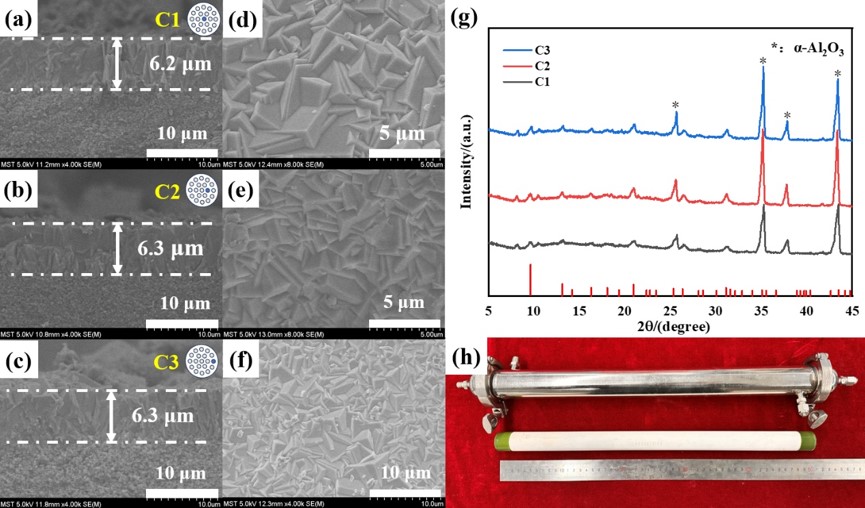
50 cm Tubular Outer Membrane
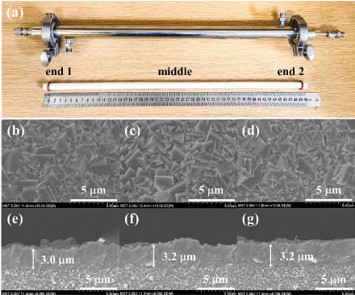
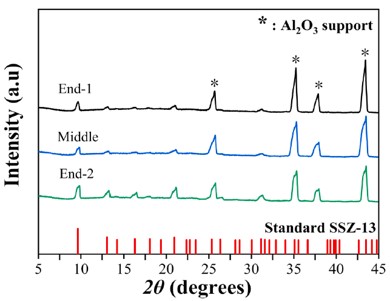
- Element length
- 50 cm
- Outer / inner diameter
- 12 mm / 8 mm
- Membrane thickness
- ~3 μm
- Effective membrane area
- ~0.018 m²
Silicalite-1 molecular sieve membranes possess a pure-silica MFI (ZSM-5) framework with uniform pore size of approximately 0.55 nm, enabling precise molecular sieving. Their intrinsic hydrophobicity and organophilicity, combined with excellent thermal and chemical stability, make them particularly suitable for recovering alcohols from dilute aqueous solutions and for separating organic isomers with close boiling points (e.g., xylenes). The separation process is based on the synergistic effect of adsorption affinity and diffusional differences, maintaining both high flux and high selectivity even under harsh operating conditions. Compared with conventional distillation processes, it can save 30%-70% of energy consumption.
Performance Snapshot
n-Butane / Isobutane
Gas phase · 5/5
>=20
Separation factor
>=100 GPU
Permeation rate
n-Pentane / Isopentane
Gas phase · 5/5
>=20
Separation factor
>=100 GPU
Permeation rate
n-Hexane / Dimethylpentane
Gas phase · 1/1/1
>=40
Separation factor
>=200 GPU
Permeation rate
n-Hexane / Trimethylpentane
Gas phase · 1/1/1
>=60
Separation factor
>=200 GPU
Permeation rate
Advanced technological implementations defining the next generation of membrane performance.
The fully siliceous framework imparts strong hydrophobicity and organophilicity, yielding superior selective permeation in water-containing organic mixtures - particularly suited to organic-solvent dehydration processes.
The all-silica inorganic framework supports long-term operation under harsh conditions including elevated temperature, strong acids, strong bases, and organic solvents - with service life significantly exceeding that of organic polymeric membranes.
Uniform ~0.55 nm apertures aligned with MFI channel geometry enable efficient separation of size-similar molecules such as n-/iso-alkanes and aromatic isomers, with separation factors of 20 or higher.
Multi-channel modules deliver up to 0.2-0.45 m2 membrane area per element and packing densities of 200-400 m2/m3 - providing industrial-scale throughput while maintaining high separation selectivity.
Process Architecture
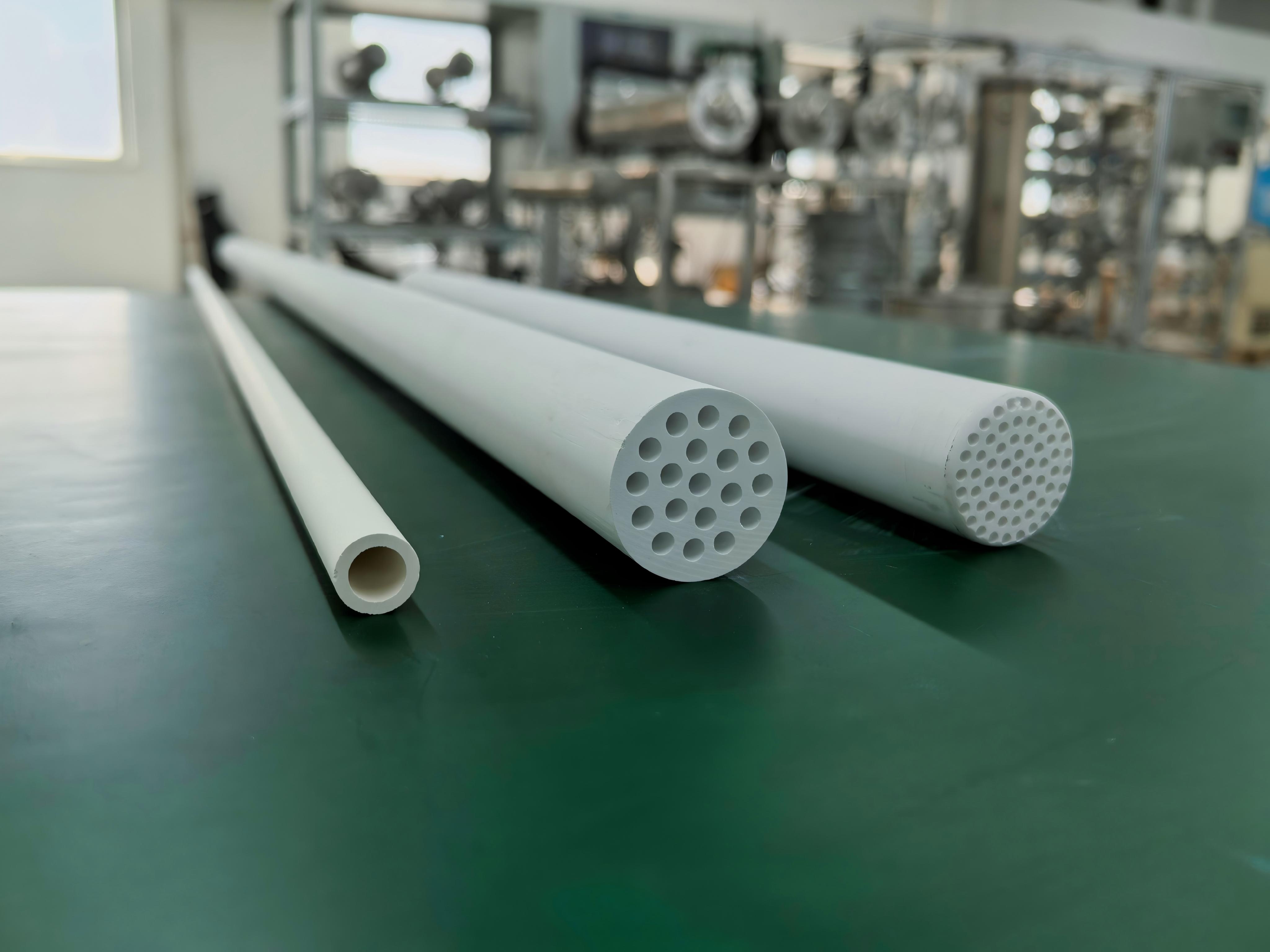
Built on an MFI-framework pure-silica skeleton, separation is achieved by size-exclusion through uniform ~0.55 nm channels acting on n-/iso-isomers. Tubular and multi-channel configurations address different plant scales, with installed membrane areas from 0.7 to 16.2 m2 - suited to hydrocarbon isomer separation.
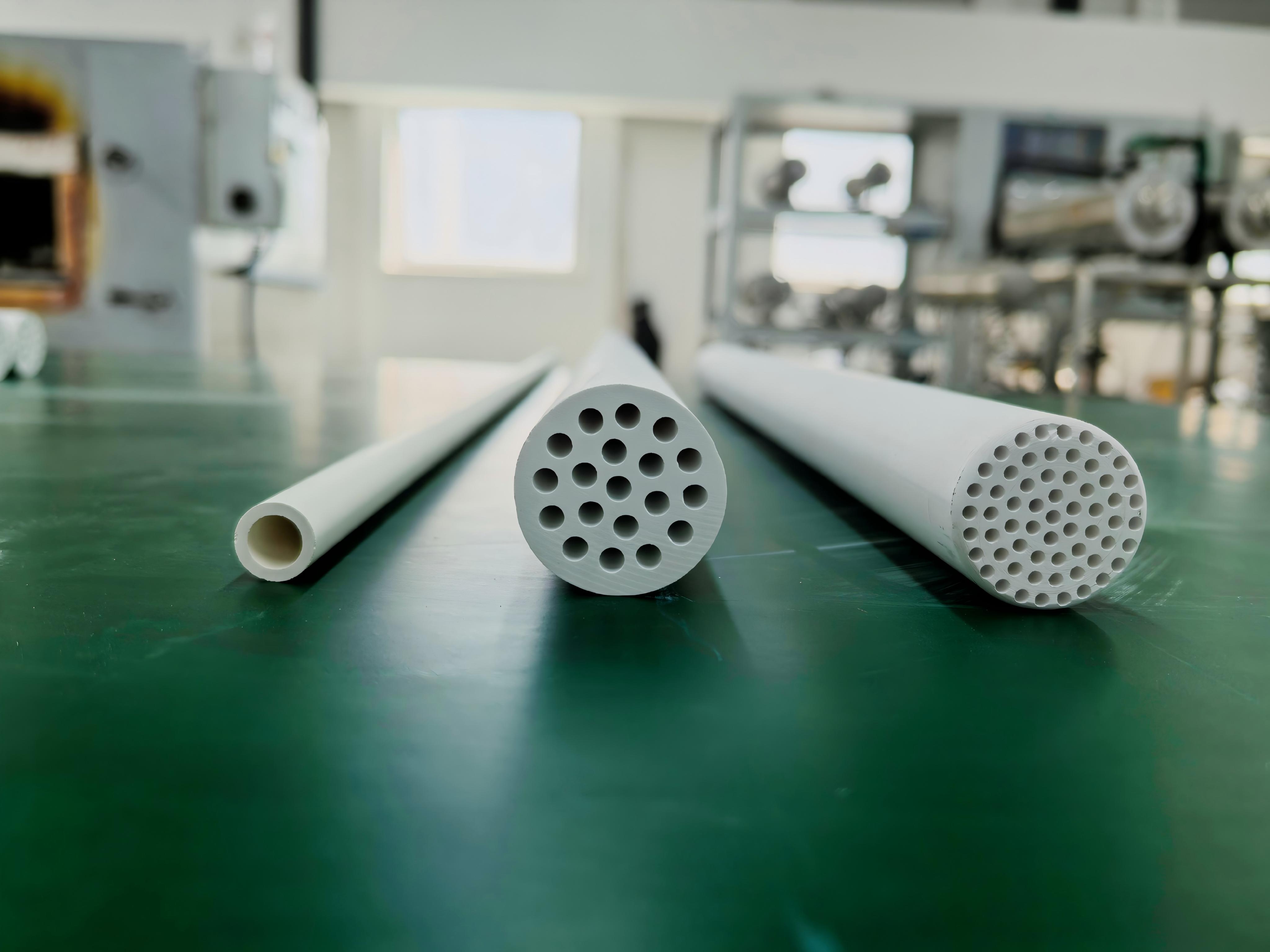
Standard specifications for tubular and multi-channel molecular sieve membranes under reference test conditions.
| Parameter | Tubular | Multi-channel |
|---|---|---|
| Membrane dimensions (ID / OD / length), mm | 8 / 12 / 500-1000 | 2-4 / 30-40 / 500-1000 |
| Number of channels | Single channel | 19 / 37 / 61 |
| Membrane area per element (1 m length), m2 | 0.037 | 0.2-0.45 |
| Installed membrane area, m2 | 0.7-1.9 | 3.8-16.2 |
| Packing density, m2/m3 | 50-80 | 200-400 |
| n-Butane permeance | 300-800 GPU | 150-800 GPU |
| n-/iso-Butane separation factor | >=20 | |
| Applicable systems | Hydrocarbon isomer separationdehydration of acidic organic solvents | |
Module Design
Standard tubular and multi-channel membrane element dimensions and effective membrane area.
Field Deployment
Representative vertical and horizontal R&D programs and pilot-scale deployments demonstrating Silicalite-1 membrane technology in industrial gas treatment.
Representative MFI / Silicalite-1 membrane programs in reforming, light-hydrocarbon separation, and process equipment development.
Conventional methane reforming for hydrogen is constrained by reaction equilibrium, requiring high temperature and high overall energy intensity. This program developed an MFI zeolite membrane–reaction coupled membrane reactor for methane steam reforming.
High-temperature and high-pressure reactor structure and sealing were optimized. At 450 °C, timely hydrogen removal through the membrane unit raised methane conversion by 20% versus equilibrium conversion, while supporting a wide space-velocity window of 500–5,000 h⁻¹.
A membrane–reaction coupled kinetic model was established to examine concentration polarization and operating conditions, with full experimental reports and equipment documentation delivered to support lower-temperature, higher-efficiency hydrogen production.
Pentane isomers in petrochemical streams are difficult and energy intensive to separate by conventional distillation. This program developed and strengthened inorganic microporous MFI membranes for isomer separation in pentane mixtures.
Under vapor permeation, the n-/cyclopentane separation factor exceeded 15 with permeance ≥100 GPU; with real mixed feeds, permeate-side n-pentane concentration reached ≥95%, and stability testing exceeded 50 hours.
Small-scale membrane modules were designed, fabricated, and evaluated, with complete test reports, process documentation, and patent planning to support low-energy C5 isomer membrane separation.
Conventional light-hydrocarbon separation processes are complex, space intensive, and demanding in temperature control and sealing. This program developed zeolite inner-channel membrane modules and packaged separation equipment for n-butane/isobutane and related systems.
High-temperature and swelling-resistant tubular inner-membrane sealing structures were developed, internal channels were optimized with turbulence promoters to mitigate concentration polarization, and a unit with effective membrane area ≥1.0 m² was built for precise independent temperature control at 60–120 °C and pressure duty of 0.05–0.25 MPa.
Overall design, assembly, pressure testing, and temperature commissioning were completed, with full drawings and operating guides delivered to support engineering application of light-hydrocarbon membrane separation.
n-Butane and isobutane are close in physical properties, making conventional separation energy intensive, while long industrial membrane tubes and high-density modules pose scale-up challenges. This program developed MFI zeolite membrane equipment for C4 butane separation.
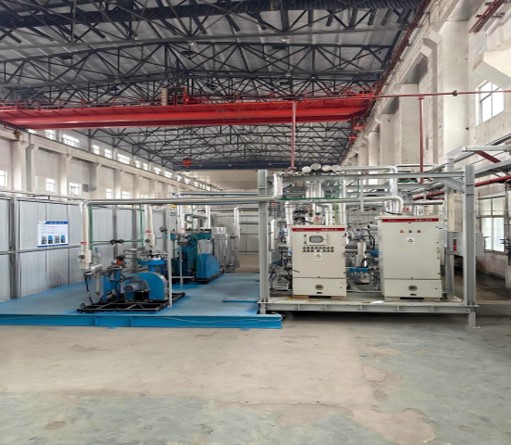
Industrial membranes of 80–100 cm were prepared with fast quality-inspection methods; sealing and flow-field structures were optimized to raise packing density and suppress concentration polarization. A hundred-square-meter skidded pilot sideline unit reached about 100 kg/h throughput, delivering isobutane purity ≥98.5% and permeate-side n-butane ≥87%, with thousand-hour continuous stability testing.
Full design drawings, test data, and economic assessments were delivered, addressing long-membrane fabrication and industrial module scale-up for C4 isomer membrane separation.
Separation of n-/isobutane, n-/isopentane and related light-hydrocarbon isomers is difficult and energy intensive, and trace impurities can further complicate performance. This program applied MFI zeolite membranes to multi-system light-hydrocarbon separation under application-oriented conditions.
Tests simulating plant conditions and impurity-containing feeds achieved permeate-side n-butane enrichment ≥95% at target pressures, with stability testing above 200 hours. Parallel studies covered CO₂-containing feeds, post-ether C4, and n-/isopentane systems, examining temperature, pressure, and feed composition effects.
A complete multi-system evaluation report clarified impurity impacts and provided core experimental data for subsequent engineering development of light-hydrocarbon membrane processes.
High-temperature water–CO₂–hydrocarbon mixed gases are complex to separate by conventional long process trains that are energy intensive and prone to hydrocarbon loss. This program used a dual-membrane coupling process for sequential dehydration and decarbonization.
High-temperature sealed modules were developed with optimized internal flow fields and higher packing density to suppress concentration polarization. Under high-temperature and high-pressure duty, both dehydration and decarbonization membranes delivered high permeance and selectivity; overall CO₂ recovery exceeded 95%, heavy-hydrocarbon loss remained low, and continuous stability testing exceeded 200 hours.
A multi-module series demonstration unit validated simulated and real-duty cases, with full test and closing reports supporting energy-efficient membrane separation of multicomponent hot mixed gases.
Conventional n-/isobutane separation is energy intensive, and batch fabrication of long tubular zeolite membranes plus industrial module scale-up remain bottlenecks. This program scaled 50 cm tubular MFI membrane fabrication and developed on-site sideline pilot technology.
Key challenges such as long-tube seed coating and uniform temperature-field control were addressed to raise fabrication yield; high packing-density modules with improved sealing and flow fields reduced concentration polarization. Elements achieved n-butane permeance above 270 GPU. An on-site sideline pilot completed 1,000-hour continuous testing, delivering isobutane purity >98% and permeate-side n-butane purity >95%.
Multistage membrane-process simulation and feasibility validation produced complete pilot data and process/equipment design packages for industrial C4 isomer membrane separation.
C5/C6 isomers in naphtha are close in physical properties and costly to separate by conventional routes. This program developed zeolite-membrane separation of n-/iso-paraffins in naphtha.
Membrane materials suited to C5/C6 systems were screened and optimized: for C5, n-pentane permeance ≥100 GPU and n-/isopentane separation factor ≥50; for C6, n-hexane permeance ≥100 GPU with high selectivity versus branched isomers. Module internals were optimized to intensify turbulence and cut concentration-polarization losses, enabling single-element area ≥0.1 m².
Temperature, pressure, and operating-mode effects on separation and energy use were studied, and a hundred-ton-per-year pilot process package with drawings was delivered, together with full technical reports and patent planning for low-energy naphtha isomer membrane separation.
| Application scenario | Project source / Partner | Project name |
|---|---|---|
| Post-alkylation C4 separation and purification | Yellow River Delta Jingbo Institute of Chemical Research Co., Ltd. / Jingbo–Nanjing Tech Joint Lab | Development of molecular sieve membrane separation equipment for C4 butane |
| Post-alkylation C4 separation and purification | National Key R&D Program of China | Preparation and application technology of high packing-density inorganic microporous membranes |
| Post-alkylation C4 separation and purification | National Natural Science Foundation of China | Research on precise construction and transport mechanisms of advanced microporous membranes for efficient separation of same-carbon-number alkanes |
| Naphtha cracking separation and purification | Sinopec (Shanghai) New Materials Research Institute Co., Ltd. | Enhancement of inorganic microporous membrane separation of pentane isomers and performance |
| Naphtha cracking separation and purification | Sinopec (Shanghai) New Materials Research Institute Co., Ltd. | Enhancement of MFI zeolite membrane separation of pentane isomers and performance |
| Naphtha cracking separation and purification | PetroChina Petrochemical Research Institute | Development of naphtha membrane separation process |
Common engineering inquiries and essential documentation for integration planning.
Under recommended operating conditions, the pure-silica MFI framework provides excellent thermal and chemical stability, typically supporting 3-5 years or more of continuous operation. Periodic module regeneration (e.g., high-temperature calcination or solvent flushing) helps restore permeation performance and extend service life.
Tubular membranes offer a simpler geometry and ease of cleaning - suited to laboratory, pilot-scale, or feeds containing particulates. Multi-channel modules provide larger membrane area per element (0.2-0.45 m2) and higher packing density (200-400 m2/m3), making them preferable for industrial continuous production where throughput is the primary requirement.
Typical applications include separation of hydrocarbon isomers such as n-/iso-butane, n-/iso-pentane/cyclopentane, and n-hexane/dimethylpentane/trimethylpentane; o-xylene/p-xylene separation; and dehydration of organics such as ethanol and isopropanol via pervaporation.
Yes. The Silicalite-1 framework is fully siliceous and exhibits good chemical stability in acidic organic solvent environments, tolerating moderate concentrations of organic acids. Prolonged exposure to strongly alkaline media is not recommended, as it may cause framework hydrolysis.